


How to cope with generalized anxiety disorder
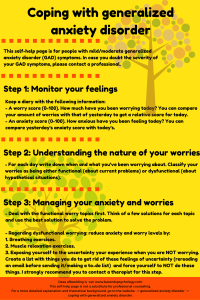
Coping with generalized anxiety disorder (GAD) is not simply a matter of “worrying less.” In practice, it often means learning how to respond differently to uncertainty, overthinking, and the urge to mentally prepare for everything that could go wrong.
For many people with GAD, worry functions as a coping strategy. It creates the feeling that they are staying alert, preventing mistakes, or reducing the chance that something bad will happen. In the short term, this can feel useful. In the long term, however, it usually strengthens anxiety and makes it harder to relax.
That is why coping with GAD is not about forcing yourself to “stop thinking,” but about understanding which types of worry can be addressed practically, which ones are hypothetical, and how to gradually increase your tolerance of uncertainty. You can read more about the broader pattern on the generalized anxiety disorder page.
This page focuses on self-help strategies for mild to moderate generalized anxiety disorder. If your symptoms are severe, highly persistent, or strongly affect your sleep, work, or relationships, self-help alone may not be enough. In that case, it may be more effective to seek professional treatment for GAD.
Below, you will find practical steps that can help you better understand your worries, reduce the grip they have on your daily life, and respond to anxiety in a more effective way.
Quick facts about coping with GAD
- Coping with GAD is largely about learning to tolerate uncertainty
- Not all worries are the same: some are practical, others are hypothetical
- Worry often feels useful in the short term, but usually maintains anxiety over time
- Helpful coping strategies focus on awareness, behavioral change, and emotional regulation
- Self-help can be useful for mild to moderate symptoms
- If symptoms are severe or persistent, professional support is often more effective
Do you feel like worry is taking over more and more of your daily life?
If it has become difficult to switch off your thoughts, make decisions, or relax, professional guidance can help you reduce anxiety more effectively than trying to manage everything on your own.
Schedule a free initial consultation
You can also take a generalized anxiety disorder test for a first indication of your symptoms.
Explore this topic
- What is generalized anxiety disorder?
- Generalized anxiety disorder symptoms
- Causes of generalized anxiety disorder
- Treatment for generalized anxiety disorder
- Diagnosing generalized anxiety disorder
- Living with someone who has generalized anxiety disorder
- Generalized anxiety disorder test
- Interesting GAD facts
- Online counseling for generalized anxiety disorder
- Back to homepage
Coping with generalized anxiety disorder – 1. Monitor your anxiety and worry patterns
People with generalized anxiety disorder (GAD) are often highly sensitive to perceived setbacks. A small mistake or uncertain situation can quickly escalate into a chain of “what if” thoughts, where one concern leads to another more serious outcome.
In practice, this means that anxiety is not only about what happens, but about how the mind interprets and builds on events. A minor issue can feel like the beginning of something much larger.
Because of this, progress is rarely linear. Some days will feel easier, while others may feel more intense. Coping with GAD is therefore not about having “perfect days,” but about understanding patterns over time.
Monitoring your anxiety and worry helps you step out of the automatic cycle and see what is actually happening. It shifts your focus from “How do I stop this?” to “What is my mind doing, and when?”
How to track your anxiety effectively
- Daily anxiety level (0–100): At the end of each day, rate your overall anxiety. For example: “Yesterday I was at 50, today I felt more tense, so I rate it 65.”
- Daily worry level (0–100): Rate how much time or energy you spent worrying. This helps you distinguish between feeling anxious and actively engaging in worry.
- Identify triggers: Briefly note when your anxiety increased. What situation, thought, or uncertainty triggered it?
- Notice patterns over time: After a week or two, look for patterns. Are there specific moments, topics, or situations that consistently increase worry?
This process helps you develop awareness and distance from your thoughts, which is a key step in reducing their impact.
Clinical insight:
“In therapy, many people initially feel that their anxiety is constant and unpredictable. But once they start tracking it, clear patterns emerge. They often discover that their anxiety spikes at specific moments, such as during decision-making, uncertainty, or quiet periods. This awareness is crucial, because you cannot change a pattern you don’t recognize.”
Niels Barends, MSc
Psychologist specialized in anxiety and overthinking
Coping with generalized anxiety disorder – 2. Understanding the nature of your worries
Not all worries are the same. One of the most important steps in coping with GAD is learning to distinguish between different types of worry.
In practice, worries can be divided into two main categories:
-
Functional worries (solvable problems):
These are concerns about situations where you can take action. For example: “How will I finish this report by Monday?”
These worries can be addressed through planning and problem-solving, and lead to concrete actions. -
Dysfunctional worries (hypothetical problems):
These are “what if” scenarios about uncertain future events. For example: “What if something goes wrong during my trip?”
These worries cannot be solved in the present moment and tend to expand rather than resolve.
This distinction is crucial. Functional worries require action, while dysfunctional worries require a different response, usually involving letting go of the need for certainty.
How to apply this in practice
- Write down your main worries throughout the day
- Label each worry as functional or dysfunctional
- Highlight recurring worries that appear repeatedly
- Notice how much time is spent on worries that cannot be solved
Many people are surprised to discover that a large part of their mental energy is spent on hypothetical situations that cannot be resolved through thinking alone.
Important: Writing your worries down does not increase anxiety. In most cases, it actually reduces mental load, because your thoughts no longer need to be constantly “held” in your mind.
Clinical insight:
“A common realization in therapy is that people are trying to solve unsolvable problems. Once they see that many of their worries are hypothetical, not practical, it becomes easier to change how they respond to them. The goal is not to eliminate these thoughts, but to stop treating them as problems that require immediate solutions.”
Niels Barends, MSc
Psychologist specialized in anxiety and cognitive patterns
Coping with generalized anxiety disorder – 3. Managing your anxiety and worries
Once you understand the difference between functional and dysfunctional worries, the next step is learning how to respond to them in a more effective way. This is where real change happens.
Managing anxiety in generalized anxiety disorder (GAD) is not about eliminating thoughts, but about changing how you deal with them. In practice, this means combining problem-solving for controllable situations with learning to tolerate uncertainty in uncontrollable ones.
If you are unsure how these worry patterns develop, you can read more about the underlying mechanisms on the generalized anxiety disorder page or explore the causes of GAD.
Managing functional worries (practical problems)
Functional worries are situations where you have direct or partial control. The goal here is not to think more, but to move from thinking into structured action.
Step-by-step approach
-
Prioritize your worries:
Start with the most relevant or urgent issue. Trying to solve everything at once often increases overwhelm. -
Generate possible solutions:
Write down multiple options, even if they are not perfect. For example:
“How will I finish this report?” → adjust schedule, reduce other commitments, ask for support, break the task into smaller steps. -
Evaluate your options:
Rate each solution (e.g., 0–10) based on feasibility and effectiveness. -
Take action:
Choose one option and implement it. Avoid overthinking once a reasonable decision has been made.
This process reduces anxiety because it replaces repetitive thinking with goal-directed behavior. Instead of staying stuck in “what if,” you move toward “what can I do next?”
Clinical insight:
“In therapy, many people with GAD spend a lot of time thinking about problems they could actually solve. Once they start using a structured approach, their anxiety often decreases quickly, not because the situation disappears, but because they regain a sense of direction and control.”
Niels Barends, MSc
Psychologist specialized in anxiety and problem-solving patterns
Addressing functional worries first often reduces overall anxiety levels, making it easier to deal with the more difficult part: dysfunctional worries.
If your worries feel difficult to structure or act on, it may help to explore evidence-based treatment options for GAD, where these skills are practiced in a more guided way.
Managing dysfunctional worries (hypothetical “what if” thinking)
Dysfunctional worries are the core of generalized anxiety disorder (GAD). These are the “what if” thoughts about uncertain future situations that cannot be solved in the present moment.
Examples include:
- “What if something goes wrong?”
- “What if I made the wrong decision?”
- “What if something bad happens to someone I care about?”
These worries tend to repeat themselves and often create a sense of urgency. Even though they cannot be solved, the mind keeps returning to them in an attempt to gain certainty.
In the short term, worrying may reduce anxiety slightly, because it creates the feeling that you are “doing something.” In the long term, however, it maintains and strengthens anxiety.
Coping with GAD therefore does not mean solving these worries, but learning to respond differently to uncertainty. You can read more about this mechanism on the generalized anxiety disorder page.
Step 1: Notice the moment worry starts
The first step is recognizing when your mind shifts into worry mode. This often happens automatically and may feel like being “pulled into” a chain of thoughts.
Instead of following the thought, label it:
- “This is a hypothetical worry”
- “This is my mind trying to create certainty”
This creates distance between you and the thought, rather than getting absorbed in it.
Step 2: Regulate your physical state
Anxiety is not only cognitive, but also physical. When your body is tense, your mind is more likely to interpret situations as threatening.
-
Breathing exercise:
Slowly inhale through your nose, pause briefly, and exhale through your mouth. Repeat this for a few minutes to reduce physiological arousal. -
Muscle relaxation:
Focus on different muscle groups and consciously release tension. This helps signal to your brain that the situation is safe.
These techniques do not eliminate worry, but they reduce the intensity of the emotional response, making it easier to change your behavior.
Step 3: Shift attention instead of engaging
A common mistake is trying to “think your way out” of worry. This usually keeps the cycle going.
Instead, practice shifting your attention:
- Return to the task you were doing
- Engage in a simple activity (walking, cleaning, reading)
- Allow the thought to be present without responding to it
The goal is not to suppress the thought, but to stop treating it as something that requires action.
Step 4: Gradual exposure to uncertainty
The most effective way to reduce dysfunctional worry is to gradually increase your tolerance of uncertainty.
People with GAD often try to prevent mistakes, reduce risks, or feel completely certain before acting. This reinforces anxiety over time.
Instead, you can practice small behavioral experiments:
- Send an email without rereading it multiple times
- Make a decision without excessive comparison
- Leave a task “unfinished” without checking it repeatedly
- Allow uncertainty to be present without trying to resolve it immediately
Before doing this, write down:
- What you expect will happen
- How likely you think it is
Afterward, reflect on what actually happened. This helps your brain learn that uncertainty is often less dangerous than it feels.
Clinical insight:
“In therapy, the turning point is often when people stop trying to eliminate uncertainty and start allowing it. At first this increases anxiety, but over time something important happens: their mind stops treating uncertainty as a threat. That is when worry begins to lose its grip.”
Niels Barends, MSc
Psychologist specialized in anxiety and exposure-based approaches
Start small. The goal is not to eliminate anxiety immediately, but to gradually change your relationship with uncertainty. If this feels too difficult, structured support through therapy for GAD can help guide this process.
(Advertisement. For more information, please scroll down.)
Coping with generalized anxiety disorder – 4. When to consider professional support
Self-help strategies can be effective, especially when symptoms are mild to moderate. However, if your anxiety remains persistent, overwhelming, or continues to interfere with your daily life, it may be helpful to seek professional support.
Many people with generalized anxiety disorder (GAD) try to manage their symptoms on their own for a long time before reaching out. In practice, this often means that worry patterns have become deeply ingrained and more difficult to change without guidance.
Professional treatment focuses on understanding and changing the underlying mechanisms that maintain anxiety. Evidence-based approaches such as
cognitive behavioral therapy (CBT),
Acceptance and Commitment Therapy (ACT), and
exposure-based interventions help reduce excessive worry by increasing tolerance of uncertainty and changing habitual thinking patterns.
In some cases, persistent or highly emotional worry themes may be linked to earlier experiences. When this is the case, approaches such as EMDR can be useful in reducing the emotional intensity associated with these patterns.
Seeking support is not a sign that you “failed” to cope on your own. It is often the most effective way to move forward when anxiety has become a recurring pattern.
Do you feel stuck in constant worry or overthinking?
If your thoughts feel difficult to control or your anxiety keeps returning, professional guidance can help you understand these patterns and reduce them more effectively.
Schedule a free initial consultation
You can also start by taking a generalized anxiety disorder test.

Frequently asked questions about coping with generalized anxiety disorder
Can I cope with generalized anxiety disorder on my own?
Self-help strategies can be effective for mild to moderate symptoms. However, if anxiety is persistent or significantly impacts your daily life, professional support is often more effective.
What is the best way to stop worrying?
Trying to stop worrying directly is usually not effective. Instead, treatment focuses on changing how you respond to worry and increasing your tolerance of uncertainty.
How long does it take to reduce GAD symptoms?
This varies from person to person. Some people notice improvement within a few weeks, while others require a longer period of consistent practice or professional guidance.
When should I seek professional help?
If worry feels difficult to control, persists over time, or interferes with your work, relationships, or sleep, it may be helpful to seek support.
What treatments are most effective for GAD?
Cognitive behavioral therapy (CBT), Acceptance and Commitment Therapy (ACT), and exposure-based approaches are among the most effective treatments. You can read more about this on the treatment page.
Does coping mean getting rid of anxiety completely?
No. The goal is not to eliminate anxiety entirely, but to reduce its intensity and change how you respond to it so it has less impact on your life.