


Somatic Symptom Disorder: Symptoms, Causes, and Treatment
Written by Niels Barends, MSc, psychologist with more than 14 years of clinical experience treating anxiety, trauma-related symptoms, and somatic symptom disorder. Updated May 2026.
Somatic symptom disorder is a mental health condition in which physical symptoms, such as pain, fatigue, dizziness, gastrointestinal discomfort, or other bodily sensations, become highly distressing and difficult to manage. The symptoms may or may not be fully explained by a medical condition, but the distress and health-related anxiety are central to the disorder.
People with somatic symptom disorder are not “imagining” their symptoms. The physical discomfort is real. What makes the condition clinically significant is the way symptoms become connected to persistent worry, repeated checking, medical reassurance seeking, avoidance, fear of illness, or a strong focus on bodily sensations.
In clinical practice, somatic symptom disorder often exists at the intersection of body, stress, anxiety, and trauma. Some people develop symptoms after prolonged emotional strain, while others become increasingly preoccupied with health after illness, injury, medical uncertainty, or earlier experiences of not feeling safe in their body. Symptoms may also overlap with anxiety disorders, complex PTSD, panic symptoms, or depression.
This page explains what somatic symptom disorder is, how to recognize it, what may cause it, and which treatment options can help. You can also explore our pages about causes of somatic symptom disorder, treatment for somatic symptom disorder, or take the somatic symptom disorder test.
Key facts about somatic symptom disorder
- Somatic symptom disorder involves distressing physical symptoms combined with excessive thoughts or feelings related to those symptoms.
- The physical symptoms are real, even when they are not fully explained by a medical condition.
- Common symptoms include pain, fatigue, gastrointestinal complaints, dizziness, or other persistent bodily sensations.
- Somatic symptom disorder often overlaps with health anxiety, trauma, depression, and anxiety disorders.
- Symptoms must usually be persistent, often lasting six months or longer.
- Treatment may include cognitive behavioural therapy (CBT), trauma-focused therapy, and approaches that improve emotional regulation and body awareness.
— Niels Barends, MSc, psychologist at Barends Psychology Practice
Somatic symptom disorder guide
Need help with somatic symptom disorder?
If physical symptoms, health anxiety, or fear about bodily sensations are disrupting your daily life, therapy can help you understand the pattern and reduce the distress connected to your symptoms.
What is somatic symptom disorder?
Somatic symptom disorder occurs when physical symptoms become a central source of emotional distress or functional impairment. These symptoms may include pain, fatigue, gastrointestinal discomfort, dizziness, sexual symptoms, neurological-like complaints, or other bodily sensations.
Importantly, somatic symptom disorder does not mean that symptoms are invented or “all in the head.” Many people with this condition experience genuine physical discomfort. The diagnosis focuses on the relationship between physical symptoms and the person’s thoughts, emotions, and behaviors around those symptoms.
For example, someone may become highly anxious about bodily sensations, repeatedly search for reassurance, visit doctors frequently, avoid activities out of fear of worsening symptoms, or spend large amounts of time monitoring the body. This can make the symptoms feel even more threatening and harder to manage.
In some cases, somatic symptom disorder may also occur alongside other mental health conditions involving emotional dysregulation, trauma, or heightened sensitivity to stress, such as borderline personality disorder, anxiety disorders, or PTSD.
For partners or friends, these patterns can sometimes be difficult to understand. Loved ones may struggle to know how to respond, especially when medical reassurance does not seem to reduce the person’s anxiety or distress. This can create frustration or misunderstandings within relationships.
According to diagnostic frameworks, symptoms are usually persistent and associated with excessive health-related thoughts, feelings, or behaviors for a significant period of time. In many cases, symptoms continue for at least six months.
Diagnosing somatic symptom disorder can sometimes be complicated because medical professionals first need to rule out underlying physical illnesses or medical explanations for the symptoms. In some cases, people spend years undergoing medical tests, specialist appointments, or repeated reassurance seeking before the psychological and stress-related components of the symptoms are recognized.
Recognizing somatic symptom disorder
Not everyone who experiences physical symptoms has somatic symptom disorder. Physical symptoms are common and can have many medical causes. A diagnosis becomes relevant when the symptoms are accompanied by a persistent and disproportionate level of distress, worry, checking, avoidance, or disruption in daily functioning.
People with somatic symptom disorder may feel trapped in a cycle. A physical sensation appears, the mind interprets it as threatening, anxiety increases, and the body becomes more activated. This activation may then intensify the original sensation, creating more fear and more monitoring. This cycle can become exhausting. People may find themselves constantly scanning their body, seeking reassurance, researching symptoms online, avoiding physical activity, or feeling unable to trust medical reassurance.
Common symptoms in somatic symptom disorder
Somatic symptoms can vary widely between individuals. Common examples include:
- headaches
- fatigue
- back pain
- joint pain
- abdominal pain
- bloating or gastrointestinal discomfort
- dizziness
- chest tightness or palpitations
- pain during intercourse
- numbness, tingling, or other bodily sensations
The specific symptom is not always the most important part of the diagnosis. What matters clinically is how much distress the symptom creates, how much attention it receives, and how strongly it affects everyday life.
Somatic symptom disorder usually develops between adolescence and early adulthood, although somatic symptoms can appear at any age. Some bodily complaints become more common later in life, including joint pain, memory complaints, palpitations, urological problems, or pain in the extremities [10].
What causes somatic symptom disorder?
Somatic symptom disorder usually does not have one single cause. Instead, it often develops through a combination of biological sensitivity, stress, early experiences, anxiety, trauma, learned coping patterns, and how a person has learned to interpret bodily sensations.
Some people become highly alert to physical sensations after illness, medical uncertainty, panic attacks, or prolonged stress. Others may have grown up in environments where emotions were ignored, unsafe, or difficult to express. In those cases, psychological distress may become more easily experienced through the body.
You can read more about these mechanisms on the page about causes of somatic symptom disorder.
Somatic symptom disorder and trauma
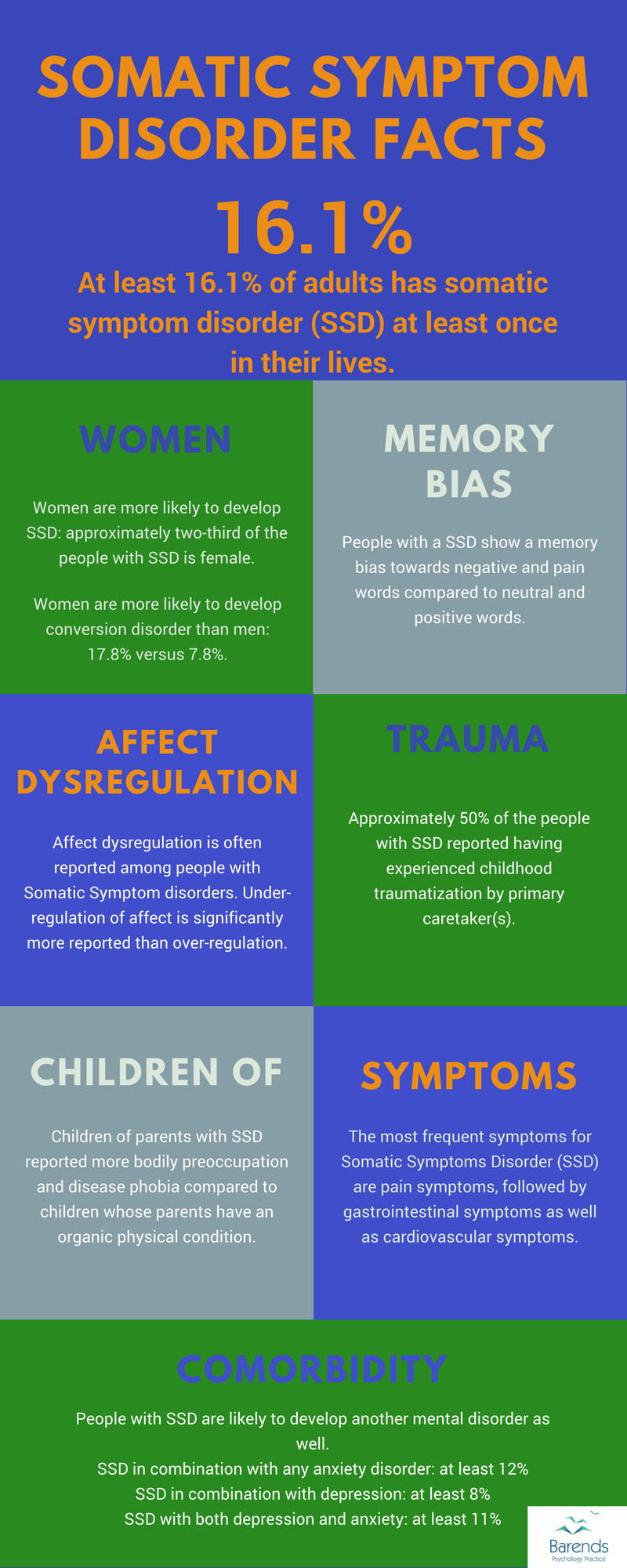
Research suggests that trauma can play an important role in somatic symptom patterns. One study found that about one in two people with somatic symptom disorder reported childhood traumatization by a primary caretaker [8]. This does not mean that trauma is always the cause, but it does suggest that early emotional safety, stress regulation, and body-based threat responses may be important in some cases.
Trauma can affect the nervous system and increase sensitivity to bodily sensations. When the body has learned to remain alert for danger, normal physical sensations may be interpreted as threatening. This can create a cycle of fear, body monitoring, and increased physical tension.
In some cases, symptoms may overlap with complex PTSD, anxiety disorders, panic symptoms, or depression. Understanding these overlaps is important because treatment may need to address both body-related fear and underlying emotional experiences.
Related conditions and overlapping symptoms
Somatic symptom disorder may overlap with several related conditions, especially when stress, trauma, anxiety, or emotional dysregulation affect how the body is experienced.
- Anxiety disorders
- PTSD and Complex PTSD
- Panic symptoms
- Depression
- Health anxiety
- Dissociation
- Chronic stress
Treatment for somatic symptom disorder
Somatic symptom disorder is treatable. Therapy usually focuses on reducing distress, changing unhelpful patterns of body monitoring, improving emotional regulation, and helping the person relate to bodily sensations in a less fearful way.
Cognitive behavioural therapy (CBT) is one of the most commonly researched treatment approaches for somatic symptom and somatoform disorders [1],[3]. CBT can help people identify catastrophic interpretations of bodily sensations, reduce reassurance seeking or avoidance, and gradually rebuild confidence in daily functioning.
Brief psychodynamic interpersonal psychotherapy has also shown benefit in patients with multisomatoform disorder [2]. When trauma plays an important role, trauma-focused therapy or EMDR may also be considered. Research on EMDR for medically unexplained symptoms is still preliminary, but suggests that trauma-focused treatment may be useful for some individuals [9].
You can learn more on the page about somatic symptom disorder treatment.
When to seek professional help
It may be helpful to seek professional support if physical symptoms are causing significant distress, repeated worry, avoidance, or disruption in daily life. This is especially important if medical reassurance does not reduce fear, if you spend a lot of time monitoring your body, or if symptoms affect work, relationships, sleep, or emotional wellbeing.
A psychologist or psychiatrist can help assess whether the pattern fits somatic symptom disorder, anxiety, trauma-related symptoms, depression, or another condition. Professional support can also help you develop a more stable and less fearful relationship with your body.
Struggling with somatic symptoms or health anxiety?
If physical symptoms and health-related worry are taking over your daily life, professional support can help you understand the pattern, reduce fear around bodily sensations, and regain a greater sense of safety and control.
Frequently asked questions about somatic symptom disorder
Is somatic symptom disorder the same as hypochondria?
No. Somatic symptom disorder focuses on distressing physical symptoms and the emotional and behavioral response to those symptoms. Health anxiety or illness anxiety may involve fear of having a serious illness, sometimes even with few physical symptoms.
Are the symptoms in somatic symptom disorder real?
Yes. The symptoms are real and can be very distressing. Somatic symptom disorder does not mean someone is pretending. The clinical focus is on how symptoms, fear, attention, and behavior interact over time.
Can trauma cause somatic symptoms?
Trauma can contribute to somatic symptoms in some people. Chronic stress and trauma may affect the nervous system, body awareness, emotional regulation, and the way physical sensations are interpreted.
Can somatic symptom disorder be treated?
Yes. Treatment can help reduce distress, health anxiety, avoidance, and body monitoring. CBT is commonly used, and trauma-focused approaches may be helpful when symptoms are linked to traumatic experiences.
When should I seek help?
You may benefit from professional support if physical symptoms cause significant anxiety, repeated medical reassurance seeking, avoidance, or disruption in work, relationships, sleep, or daily functioning.

References
- [1] Sumathipala, A. (2007). What is the evidence for the efficacy of treatments for somatoform disorders? A critical review of previous intervention studies. Psychosomatic Medicine, 69, 889-900.
- [2] Sattel, H., Lahmann, C., Gündel, H., Guthrie, E., Kruse, J., Noll-Hussong, M., … & Schneider, G. (2012). Brief psychodynamic interpersonal psychotherapy for patients with multisomatoform disorder: randomised controlled trial. The British Journal of Psychiatry, 200, 60-67.
- [3] Kroenke, K. (2007). Efficacy of treatment for somatoform disorders: a review of randomized controlled trials. Psychosomatic Medicine, 69, 881-888.
- [4] De Waal, M. W., Arnold, I. A., Eekhof, J. A., & Van Hemert, A. M. (2004). Somatoform disorders in general practice. The British Journal of Psychiatry, 184, 470-476.
- [5] Jacobi, F., Wittchen, H. U., Hölting, C., Höfler, M., Pfister, H., Müller, N., & Lieb, R. (2004). Prevalence, co-morbidity and correlates of mental disorders in the general population: results from the German Health Interview and Examination Survey (GHS). Psychological Medicine, 34, 597-611.
- [6] Becker, S., Al Zaid, K., & Al Faris, E. (2002). Screening for somatization and depression in Saudi Arabia: a validation study of the PHQ in primary care. The International Journal of Psychiatry in Medicine, 32, 271-283.
- [7] Roca, M., Gili, M., Garcia-Garcia, M., Salva, J., Vives, M., Campayo, J. G., & Comas, A. (2009). Prevalence and comorbidity of common mental disorders in primary care. Journal of Affective Disorders, 119, 52-58.
- [8] Annemiek van, D., Julian D, F., Onno van der, H., Maarten JM, V. S., Peter GM, V. D. H., & Martina, B. (2011). Childhood traumatization by primary caretaker and affect dysregulation in patients with borderline personality disorder and somatoform disorder. European Journal of Psychotraumatology, 2, 5628.
- [9] van Rood, Y. R., & de Roos, C. (2009). EMDR in the treatment of medically unexplained symptoms: A systematic review. Journal of EMDR Practice and Research, 3, 248-263.
- [10] Rief, W., Hessel, A., & Braehler, E. (2001). Somatization symptoms and hypochondriacal features in the general population. Psychosomatic Medicine, 63, 595-602.