Fear of Commitment: Meaning, Causes, and How to Overcome It
Written by Niels Barends, MSc, psychologist with more than 14 years of clinical experience in relationship problems, attachment patterns, and emotional regulation. Updated May 2026.
Fear of commitment often appears when a relationship starts becoming more serious.
Fear of commitment is the tendency to feel anxious or emotionally overwhelmed when a relationship starts becoming more serious. For some people, this happens when dating becomes exclusive. For others, it appears when partners discuss living together or deeper emotional intimacy.
Many people with a fear of commitment genuinely want love and connection. Yet as the relationship deepens, they may begin to doubt their feelings or feel an increasing need for independence. At the same time, they may still want reassurance that the relationship is secure. This creates an exhausting push-pull dynamic that can leave both partners confused and frustrated. In some relationships, this cycle may also lead to stonewalling, where one partner withdraws emotionally while the other increasingly tries to reconnect. Similar patterns can also be seen in reassurance seeking in relationships and other recurring relationship problems.
In my clinical work, fear of commitment usually reflects an internal conflict between the desire for closeness and the fear of what closeness might bring, such as rejection or emotional vulnerability. This is why fear of commitment is closely related to attachment styles, communication patterns, and trust issues.
This page explains what fear of commitment means, why it develops, how it affects relationships, and what you can do to overcome it.
Quick facts about fear of commitment
Fear of commitment is the fear of taking a relationship or life decision to the next level.
It often appears as feeling trapped, needing distance, doubting the relationship, or avoiding future plans.
Some people fear commitment because past relationships caused emotional pain.
Others fear commitment because they associate commitment with losing freedom or independence.
Fear of commitment can create mixed signals: wanting closeness but pulling away when closeness increases.
The problem is usually what commitment emotionally represents.
Therapy can help when avoidance, anxiety, or repeated relationship patterns become difficult to change.
Quick guide: fear of commitment
Use the navigation below to jump to the section most relevant to you.
Fear of commitment can create confusion, distance, and repeated relationship patterns. Professional counseling can help you understand what commitment represents for you and how to build healthier emotional security.
Fear of commitment is not simply the fear of being in a relationship. Many people with commitment fear genuinely want love and stability. The difficulty tends to appear when a relationship requires greater emotional investment, vulnerability, or long-term responsibility.
What makes commitment anxiety confusing is that the same behaviour can have very different psychological causes. Two people may both hesitate when a relationship becomes more serious, yet the reason behind their hesitation may be completely different.
For example, a Catalyst may fear commitment because commitment feels limiting. As the relationship becomes more serious, thoughts such as “What if I lose my freedom?” or “What if I miss other opportunities?” start becoming more prominent. The desire for connection competes with the desire for possibility and independence.
An Attuner, on the other hand, may fear commitment because deeper commitment increases the risk of emotional pain. As intimacy grows, thoughts such as “What if they leave?” or “What if I invest everything and it falls apart?” can become more powerful. The desire for connection competes with the fear of rejection or loss.
Although the behaviour may look similar from the outside, emotionally distancing or creating uncertainty, the underlying motivation is very different. One person is protecting freedom, while the other is protecting themselves from emotional pain.
Clinically, fear of commitment is often best understood as a protective strategy. The person avoids the next step because that step feels emotionally risky. Unfortunately, the same strategy that protects against disappointment can also prevent the closeness and emotional connection that the person genuinely wants.
Catalyst vs Attuner: Two Different Forms of Commitment Fear
Learning that commitment does not eliminate freedom
Learning that vulnerability does not automatically lead to rejection
Although both archetypes can struggle with commitment, their motivations are very different. The Catalyst protects freedom, while the Attuner protects against emotional pain. Understanding which pattern is driving the fear is often the first step toward changing it.
Which pattern sounds most familiar?
Fear of commitment can look very different from one person to another. Some people pull away because they fear losing freedom. Others hesitate because deeper commitment increases the risk of rejection or emotional pain.
Understanding your Relational Archetype can help explain why certain relationship patterns keep repeating and how commitment becomes difficult under pressure.
Free assessment • Takes approximately 5 minutes • Instant results
Signs of fear of commitment
Fear of commitment can show up in different ways. Some signs are obvious, while others look more like confusion or “not being ready.”
Feeling trapped when a relationship becomes more serious.
Repeatedly doubting whether your partner is “the one.”
Wanting closeness but pulling away when intimacy increases.
Avoiding conversations about the future.
Ending relationships when they become emotionally serious.
Finding reasons why the timing is never right.
Focusing on your partner’s flaws when commitment becomes possible.
Feeling anxious when your partner wants clarity or consistency.
Using work, freedom, lifestyle, or uncertainty as reasons to avoid deeper commitment.
Not everyone who has doubts has fear of commitment. Doubt can also be a healthy signal that something in the relationship needs attention. The key question is whether the same pattern keeps repeating across different relationships.
Two common types of fear of commitment
In practice, I often see two common forms of fear of commitment. They may look similar from the outside, but they are driven by different emotional motives.
Type 1: Fear of being hurt again
Some people fear commitment because previous relationships caused emotional pain. They may have been rejected or deeply disappointed. These people often want a serious relationship, but they become afraid when closeness makes them vulnerable again. For them, vulnerability often reminds them of these past, painful, experiences.
In this type, fear of commitment protects the person from future pain.
Type 2: Fear of losing freedom
Other people fear commitment because they associate it with losing independence. Commitment may feel like giving up personal space or being forced into adult responsibilities before they feel ready. In this type, fear of commitment often hides deeper doubts about whether the person can handle the responsibilities of a serious relationship. Being responsible goes hand in hand with evaluation moments where someone could fail.
Both types may use similar explanations: “I feel trapped,” “I am too busy,” “I need more freedom,” “I am not sure this is the right person,” or “Things are fine the way they are.” But the emotional reason behind these explanations can be very different.
Fear of commitment after past relationships
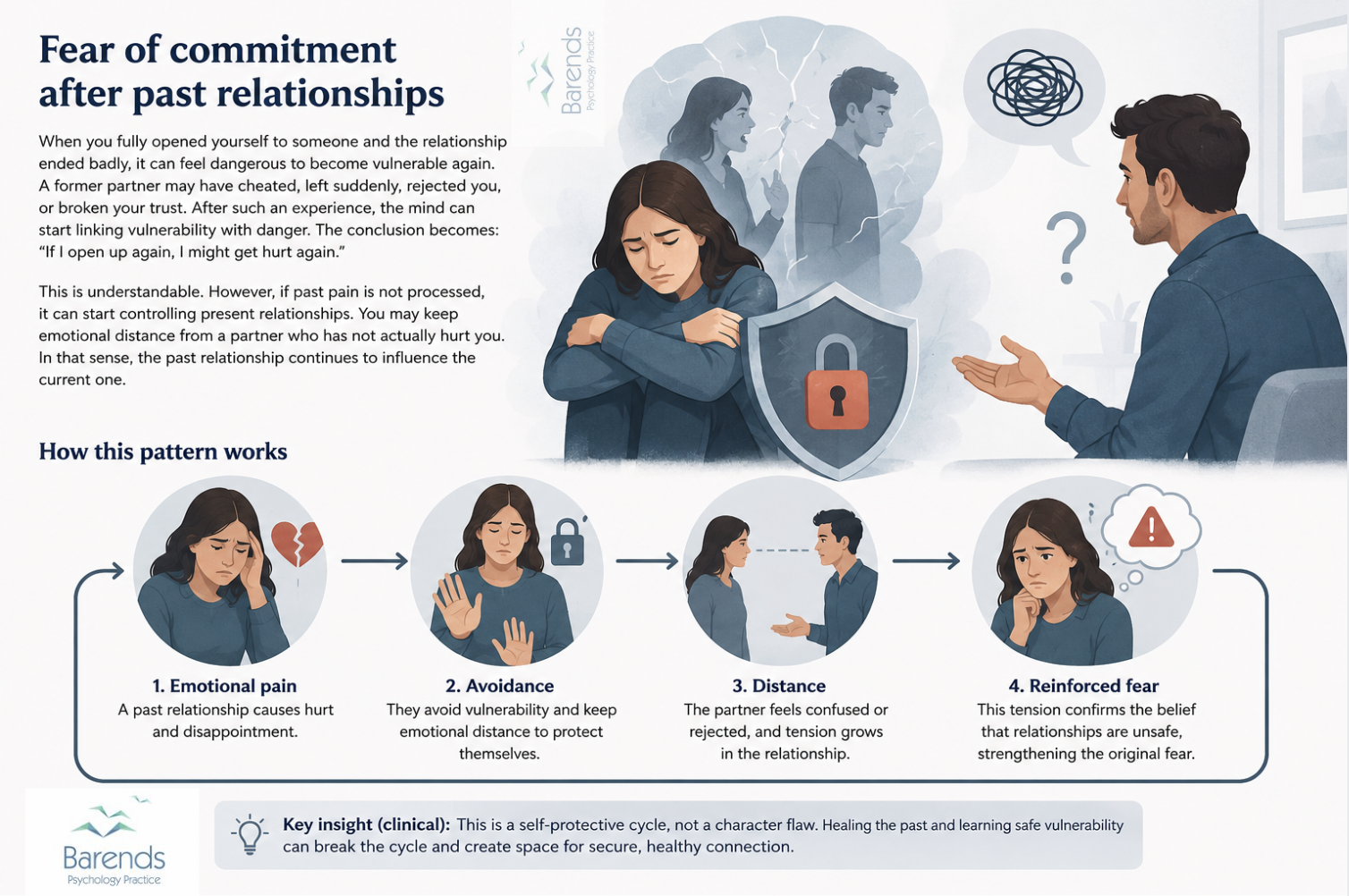
When you fully opened yourself to someone and the relationship ended badly, it can feel dangerous to become vulnerable again. A former partner may have cheated, left suddenly, rejected you, or broken your trust. After such an experience, the mind can start linking vulnerability with danger. The conclusion becomes: “If I open up again, I might get hurt again.”
This is understandable. However, if past pain is not processed, it can start controlling present relationships. You may keep emotional distance from a partner who has not actually hurt you. In that sense, the past relationship continues to influence the current one.
How this pattern works
Fear of commitment cycle.
After having been hurt in a previous relationship, they may begin avoiding situations where they feel vulnerable. They may stop talking about deeper feelings or prevent themselves from developing strong emotional attachment, which often creates distance.
The current partner may feel confused or rejected, and may start pushing for clarity. The person with fear of commitment may then interpret this tension as proof that relationships are unsafe, which reinforces the original fear.
This creates a self-protective cycle: emotional pain leads to avoidance, avoidance creates distance, and distance increases insecurity in the relationship.
What can help?
When fear of commitment is connected to past hurt, it is important to process the emotional impact of that experience. This does not mean forcing yourself to trust immediately. It means gradually learning that the past and present are not the same.
Talk about the pattern. Speaking with a psychologist or trusted person can help you understand how past experiences still affect your current reactions.
Consider trauma-focused support. If the memories are intense or intrusive, approaches such as EMDR therapy may help reduce the emotional charge connected to past betrayal or rejection.
Open up gradually. Tell your current partner that closeness can feel difficult for you. Ask for patience, but also take small steps toward emotional openness.
Create corrective experiences. Healthy vulnerability in a safe relationship can slowly weaken the belief that closeness always leads to pain.
Fear of commitment and fear of losing freedom
For some people, fear of commitment is less about past rejection and more about the fear of losing freedom or independence. Commitment may feel like giving up personal space, autonomy, or control over one’s own life.
People with this pattern often think: “Then I am stuck” or “I will constantly have responsibilities and expectations.” On the surface, the fear appears to be about freedom itself. However, in clinical practice, the underlying issue is often more complex.
Commitment not only brings closeness, but also emotional responsibility. A serious relationship creates expectations, vulnerability, and the possibility of disappointing someone or eventually being rejected. For some individuals, the deeper fear is not losing freedom itself, but doubting whether they can successfully maintain a long-term relationship. In that sense, fear of commitment may partly reflect insecurity, fear of failure, or low relationship self-esteem.
For others, the fear is more strongly connected to autonomy and control. Commitment may unconsciously trigger older emotional experiences related to criticism, pressure, overcontrol, or a lack of emotional freedom during childhood. As a result, emotional closeness can start to feel psychologically restrictive, even when the current partner is not actually controlling.
This helps explain why some people repeatedly postpone deeper commitment while still wanting emotional connection. Avoiding commitment temporarily reduces anxiety, but it also prevents the person from discovering that relationships can remain stable without losing their identity or independence.
How this pattern works
A person with this type of fear of commitment may start seeing relationships mainly in terms of restriction, pressure, or emotional risk. They may compare their own life to couples who appear stressed, dependent, or unhappy, which reinforces the belief that commitment leads to losing freedom or becoming trapped.
In reality, this fear is often maintained through selective attention. People naturally notice information that confirms what they already fear while overlooking examples that contradict it. Someone who believes commitment leads to loss of independence may focus mainly on the sacrifices of relationships while ignoring couples who maintain both emotional closeness and personal autonomy.
Underneath this pattern there is often a deeper insecurity. Some individuals fear that they will not be able to handle the emotional responsibilities of a long-term relationship, while others fear disappointing their partner or eventually being rejected. Avoiding commitment temporarily reduces this anxiety, but it also prevents emotional growth and deeper connection.
What can help?
Clarify what commitment actually means. Healthy commitment does not require losing your identity, independence, or personal freedom. Open conversations about expectations and boundaries can reduce unrealistic fears.
Examine the underlying fear. Ask yourself whether the fear is truly about freedom, or whether it is connected to insecurity, fear of failure, emotional dependence, or fear of being controlled.
Challenge selective thinking. Instead of focusing only on the negative examples of relationships, consciously notice examples of couples who maintain both stability and individuality.
Take gradual steps. Emotional closeness and commitment do not need to happen all at once. Small experiences of trust and vulnerability can help reduce fear over time.
Consider professional support. When fear of commitment is strongly connected to childhood experiences, low self-esteem, or repeated relationship patterns, therapy can help address the deeper emotional dynamics behind the fear.
Fear of commitment: advice for couples
When one partner has fear of commitment, both partners can become stuck in a painful cycle. One partner asks for clarity, while the other feels pressured. The more one partner pushes, the more the other withdraws. The more one withdraws, the more insecure the other becomes.
A helpful first step is to stop framing the issue as a simple lack of love. Fear of commitment does not always mean that someone does not care. It may mean that closeness activates fear, pressure, shame, or uncertainty.
Couples can benefit from discussing practical questions:
What does commitment actually mean to each partner?
Which specific step feels frightening?
What would change in daily life?
What kind of freedom or reassurance does each partner need?
What would be a realistic next step rather than a dramatic leap?
For some couples, it can help to experiment with a “small commitment” for a limited period. For example, partners may agree to communicate more consistently, spend more structured time together, or talk honestly about future expectations without making immediate major decisions.
If conversations quickly become defensive or emotionally intense, relationship counseling can help create a safer structure for these discussions.
Fear of commitment when you are dating
Fear of commitment can also appear early in dating. Things may go well at first, but as emotional closeness increases, anxiety appears. You may start questioning whether the other person is right for you, whether you are ready, or whether you should keep your options open.
Sometimes these doubts are important signals. Not every dating situation should become a relationship. But if you notice the same pattern with many people, it may be worth asking whether the issue is really compatibility or fear.
If you are dating someone and feel afraid to open up, honesty can help. You do not need to share everything immediately, but you can say that closeness sometimes makes you anxious and that you need time to build trust.
Healthy dating requires communication, honesty, and emotional pacing. You do not need to force yourself into commitment, but avoiding every vulnerable step can prevent you from discovering whether a relationship could become meaningful.
Professional help for fear of commitment
Professional support can be helpful when fear of commitment repeatedly affects relationships, dating, or major life decisions. Therapy can help identify whether the fear is mainly connected to past hurt, fear of losing freedom, low self-esteem, attachment patterns, or difficulty regulating emotions.
Depending on the underlying pattern, therapy may include cognitive behavioural techniques, schema therapy, attachment-focused work, EMDR therapy, or couples counseling. The goal is not to pressure someone into commitment, but to understand the fear clearly enough that choices become freer and less avoidant.
Ready to understand your fear of commitment?
If commitment fear is affecting your relationships, therapy can help you understand the pattern, process past experiences, and build healthier emotional security.
Author: Niels Barends, MSc, psychologist with more than 14 years of clinical experience in relationship problems, attachment patterns, fear of commitment, and emotional regulation.
Clinical focus: Relationship problems, fear of commitment, attachment styles, trust issues, emotional regulation
Approach: Evidence-based therapy, including CBT, schema therapy, EMDR therapy, and attachment-focused approaches
Last reviewed: May 2026
Frequently asked questions
Frequently Asked Questions About Fear of Commitment
Fear of commitment can look like doubt, withdrawal, anxiety, or a strong need for independence. These questions explain how to recognize the pattern and what may help.
What does fear of commitment mean?
Fear of commitment means that a person experiences anxiety, doubt, or emotional pressure when a relationship requires greater closeness or responsibility. The fear may appear when dating becomes exclusive, when future plans are discussed, or when the person feels increasingly dependent on the relationship.
What are common signs of fear of commitment?
Common signs include avoiding conversations about the future, feeling trapped when a relationship becomes serious, repeatedly doubting whether a partner is right, focusing heavily on a partner’s flaws, and pulling away when emotional intimacy increases. The same pattern may appear across several relationships.
Can someone love you and still fear commitment?
Yes. Fear of commitment does not automatically mean that someone lacks love or care. A person may genuinely want closeness while also fearing rejection, dependence, responsibility, loss of freedom, or emotional pain. Their withdrawal may reflect this internal conflict rather than a complete absence of feeling.
Is fear of commitment an attachment issue?
Fear of commitment can be influenced by attachment patterns, but attachment is not the only possible cause. Past betrayal, fear of losing independence, low relationship confidence, childhood experiences, and difficulty tolerating vulnerability may also contribute.
Why do people with fear of commitment pull away?
Pulling away temporarily reduces the anxiety connected to closeness. Distance may help the person feel more independent, less exposed, or less responsible for another person’s feelings. Unfortunately, this relief can reinforce avoidance and create more insecurity in the relationship.
What is the difference between fear of commitment and not wanting a relationship?
Someone who does not want a relationship may feel clear and consistent about that choice. A person with fear of commitment often wants closeness but becomes anxious when the relationship deepens. They may alternate between seeking connection and creating distance.
Can fear of commitment cause stonewalling?
It can contribute to withdrawal during emotionally intense conversations. A person may become silent, avoid future-oriented discussions, or stop responding when they feel pressured. This can resemble stonewalling in relationships, although not every request for space is stonewalling.
How should I respond to a partner who fears commitment?
Ask what commitment means to your partner and which specific step feels threatening. Avoid forcing immediate reassurance, but remain honest about your own needs and limits. Patience can support change, but indefinite uncertainty can damage your emotional security.
Can fear of commitment be overcome?
Yes. Change usually begins by identifying what commitment represents emotionally. The person may need to process past pain, challenge assumptions about losing freedom, develop greater tolerance for vulnerability, and practice taking manageable steps toward closeness.
What therapy helps with fear of commitment?
The most appropriate approach depends on the cause. Therapy may include cognitive behavioral techniques, Schema Therapy, attachment-focused work, EMDR for unresolved relational trauma, or couples counseling. Treatment should focus on understanding the fear rather than pressuring someone into commitment.
When should I seek professional help?
Professional help may be useful when fear of commitment repeatedly ends otherwise healthy relationships, creates severe anxiety, prevents honest decisions, or keeps a couple trapped in a push-pull cycle that they cannot change independently.
References
This article is informed by clinical experience and established psychological research on attachment, relationship patterns, avoidance, emotional regulation, and trauma processing.
Bowlby, J. (1988). A Secure Base: Parent-Child Attachment and Healthy Human Development. Basic Books.
Mikulincer, M., & Shaver, P. R. (2016). Attachment in Adulthood: Structure, Dynamics, and Change. Guilford Press.
Johnson, S. M. (2019). Attachment Theory in Practice: Emotionally Focused Therapy with Individuals, Couples, and Families. Guilford Press.
Young, J. E., Klosko, J. S., & Weishaar, M. E. (2003). Schema Therapy: A Practitioner’s Guide. Guilford Press.
Beck, A. T. (1988). Love Is Never Enough: How Couples Can Overcome Misunderstandings, Resolve Conflicts, and Solve Relationship Problems Through Cognitive Therapy. Harper & Row.
Shapiro, F. (2018). Eye Movement Desensitization and Reprocessing (EMDR) Therapy: Basic Principles, Protocols, and Procedures. Guilford Press.
Gottman, J. M., & Silver, N. (2015). The Seven Principles for Making Marriage Work. Harmony Books.
American Psychiatric Association. (2022). Diagnostic and Statistical Manual of Mental Disorders (5th ed., text rev.; DSM-5-TR). American Psychiatric Association Publishing.
To provide the best experiences, we and our partners use technologies like cookies to store and/or access device information. Consenting to these technologies will allow us and our partners to process personal data such as browsing behavior or unique IDs on this site and show (non-) personalized ads. Not consenting or withdrawing consent, may adversely affect certain features and functions.
Click below to consent to the above or make granular choices. Your choices will be applied to this site only. You can change your settings at any time, including withdrawing your consent, by using the toggles on the Cookie Policy, or by clicking on the manage consent button at the bottom of the screen.
Functional
Always active
The technical storage or access is strictly necessary for the legitimate purpose of enabling the use of a specific service explicitly requested by the subscriber or user, or for the sole purpose of carrying out the transmission of a communication over an electronic communications network.
Preferences
The technical storage or access is necessary for the legitimate purpose of storing preferences that are not requested by the subscriber or user.
Statistics
The technical storage or access that is used exclusively for statistical purposes.The technical storage or access that is used exclusively for anonymous statistical purposes. Without a subpoena, voluntary compliance on the part of your Internet Service Provider, or additional records from a third party, information stored or retrieved for this purpose alone cannot usually be used to identify you.
Marketing
The technical storage or access is required to create user profiles to send advertising, or to track the user on a website or across several websites for similar marketing purposes.
To provide the best experiences, we use technologies like cookies to store and/or access device information. Consenting to these technologies will allow us to process data such as browsing behavior or unique IDs on this site. Not consenting or withdrawing consent, may adversely affect certain features and functions.
Functional
Always active
The technical storage or access is strictly necessary for the legitimate purpose of enabling the use of a specific service explicitly requested by the subscriber or user, or for the sole purpose of carrying out the transmission of a communication over an electronic communications network.
Preferences
The technical storage or access is necessary for the legitimate purpose of storing preferences that are not requested by the subscriber or user.
Statistics
The technical storage or access that is used exclusively for statistical purposes.The technical storage or access that is used exclusively for anonymous statistical purposes. Without a subpoena, voluntary compliance on the part of your Internet Service Provider, or additional records from a third party, information stored or retrieved for this purpose alone cannot usually be used to identify you.
Marketing
The technical storage or access is required to create user profiles to send advertising, or to track the user on a website or across several websites for similar marketing purposes.