


What causes generalized anxiety disorder (GAD)?
Generalized anxiety disorder (GAD) usually does not develop because of one single cause. In most cases, it emerges gradually through a combination of psychological vulnerability, life experiences, stress, and learned coping patterns.
At the center of GAD is not just “worrying too much,” but a deeper difficulty with uncertainty, perceived threat, and mental control. Many people with GAD experience their mind as constantly scanning for potential problems, trying to predict negative outcomes, and preparing for situations that may never happen. This creates a self-reinforcing pattern in which worry starts to feel necessary, even though it increases anxiety in the long run.
Because of this, the causes of GAD are best understood as interacting factors, rather than isolated explanations. Some people are more temperamentally sensitive to uncertainty, while others develop chronic worry after prolonged stress, family patterns, or difficult life events. Cognitive habits, emotional learning, and physical stress responses can all contribute to the development and maintenance of anxiety.
If you are unfamiliar with the condition itself, you can first read more about what generalized anxiety disorder is and the symptoms of GAD. If you are already wondering whether these patterns apply to you, you can also take a generalized anxiety disorder test.
On this page, you will find an overview of the most important psychological, biological, and environmental factors associated with generalized anxiety disorder, as well as the main risk factors that can increase vulnerability over time.
Quick facts about the causes of GAD
- GAD is usually caused by a combination of factors, not one single trigger
- Important contributors include stress, temperament, cognitive patterns, and life experiences
- Intolerance of uncertainty is one of the most important psychological mechanisms in GAD
- Worry often becomes a learned coping strategy that temporarily reduces anxiety
- Over time, this coping style can maintain and strengthen anxiety symptoms
- Understanding the causes of GAD can help guide effective treatment
Do you recognize these worry patterns in yourself?
Understanding the causes of generalized anxiety disorder can help you make sense of persistent worry and take the next step toward effective treatment.
Explore this topic
- What is generalized anxiety disorder?
- What are the generalized anxiety disorder symptoms?
- Treatment for generalized anxiety disorder
- Diagnosing generalized anxiety disorder
- Coping with generalized anxiety disorder yourself
- Living with someone who has generalized anxiety disorder
- Generalized anxiety disorder test
- Interesting generalized anxiety disorder facts
- Online treatment for generalized anxiety disorder
- Back to homepage
Generalized anxiety disorder causes – genetics
Research shows that generalized anxiety disorder (GAD) is moderately heritable [1],[2]. This means that genetic factors can increase your vulnerability to developing persistent anxiety and worry patterns.
If a first-degree biological relative (such as a parent or sibling) has GAD, your risk of developing similar symptoms is higher compared to someone without this family history. However, genetics do not determine outcomes. They influence how sensitive your stress and anxiety systems are, not whether you will develop the disorder.
In practice, genetic vulnerability often shows up as:
- A tendency to experience higher baseline anxiety
- Increased sensitivity to stress or uncertainty
- A stronger emotional or physiological response to perceived threats
Importantly, genetic predisposition interacts with other factors, such as life experiences and coping patterns. This is why some people with a genetic vulnerability develop GAD, while others do not. To better understand how these patterns present, you can also read about the symptoms of generalized anxiety disorder.
Generalized anxiety disorder causes – environment and life experiences
Environmental factors play a crucial role in the development of generalized anxiety disorder (GAD). Rather than one specific event, it is usually the accumulation of experiences and learned responses that shapes how anxiety develops over time.
Research suggests that individual-specific experiences (unique events, stressors, or learning experiences) are particularly important in explaining why one person develops GAD while another does not, even within the same family [1].
Examples of environmental factors that may contribute include:
- Chronic stress (work pressure, financial stress, ongoing uncertainty)
- Unpredictable or unstable environments
- Overprotective or highly critical parenting styles
- Exposure to anxiety-related behaviors (learning worry as a coping strategy)
- Negative or stressful life events
These experiences can influence how you interpret situations, respond to uncertainty, and regulate emotions. Over time, they may contribute to patterns such as excessive worrying, hypervigilance, and difficulty tolerating uncertainty, which are central to GAD.
Rather than separating “genetics” and “environment,” it is more accurate to view GAD as the result of an interaction between both. Environmental experiences can either activate or buffer underlying vulnerability. This is also why treatment often focuses on changing learned patterns, such as worry and avoidance, rather than trying to eliminate anxiety entirely. You can read more about this on the treatment for generalized anxiety disorder page.
(Advertisement. For more information, please scroll down.)
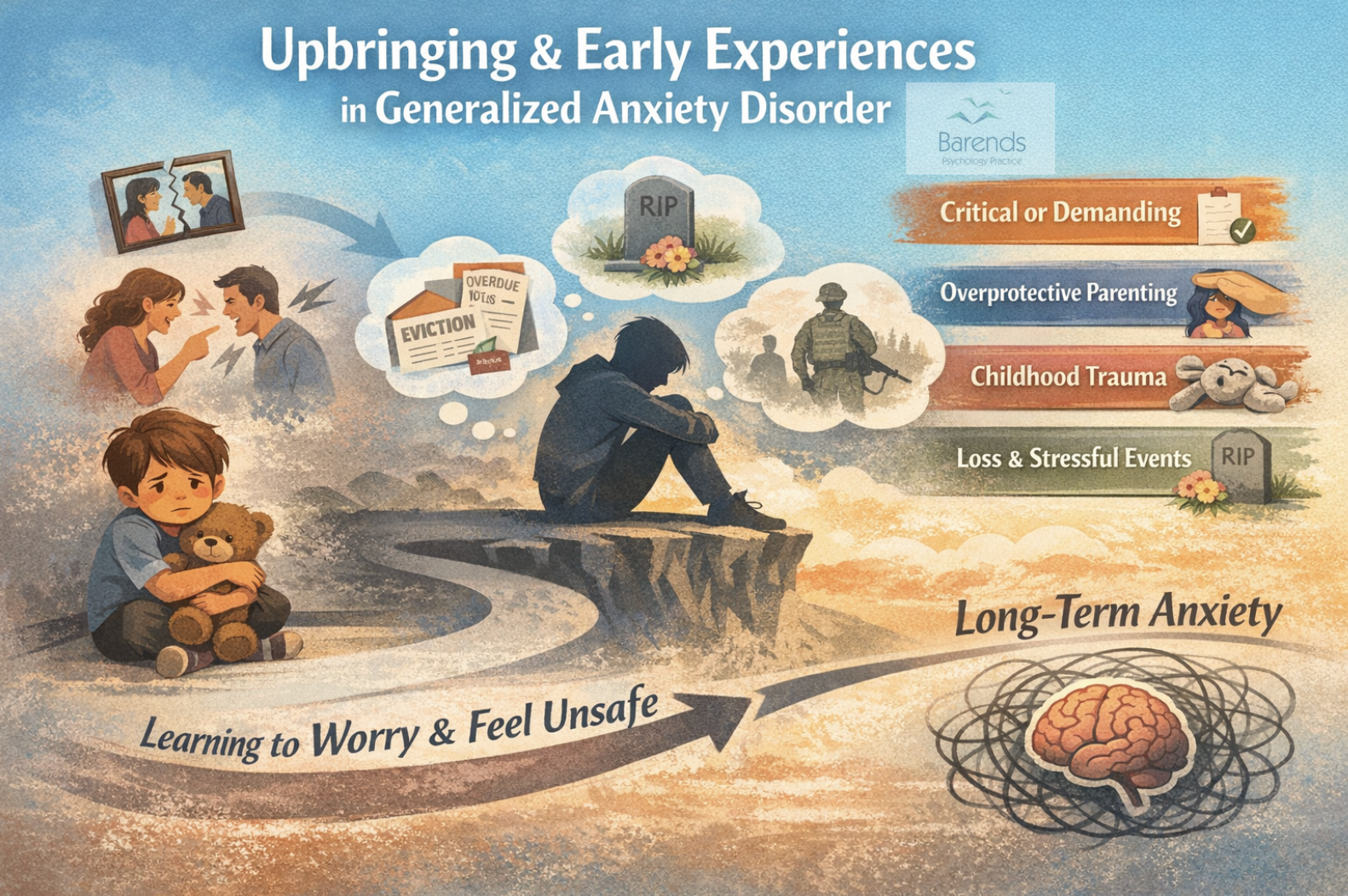
Generalized anxiety disorder causes – upbringing and early experiences
Early experiences and upbringing play an important role in the development of generalized anxiety disorder (GAD). Children learn how to interpret situations, manage emotions, and respond to uncertainty largely through observation and interaction with caregivers.
When anxiety or worry is consistently present in the environment, for example when a parent frequently anticipates problems or expresses concern about potential risks, children may gradually learn that the world is unpredictable or unsafe. Over time, this can lead to the development of worry as a default coping strategy.
In this sense, worrying is not random. It is often a learned response to uncertainty. What starts as a way to feel more prepared or in control can become automatic. As described on the generalized anxiety disorder page, this pattern can evolve into a cycle where worrying both reduces anxiety in the short term and maintains it in the long term.
In practice, this can lead to a paradoxical pattern: worrying feels necessary to stay in control, but at the same time it increases overall anxiety. In other words, the strategy that is meant to reduce anxiety becomes part of the problem.
Upbringing is not only about learned behavior, but also about emotional experiences. Environments that are:
- Highly critical or demanding
- Overprotective or controlling
- Emotionally unpredictable
- Or characterized by chronic stress or tension
can increase sensitivity to stress and uncertainty. In some cases, more intense or prolonged experiences may contribute to patterns associated with trauma. For example, ongoing emotional stress or instability can overlap with symptoms described in complex PTSD, where individuals become more vigilant, reactive, or focused on anticipating potential threats.
If you are unsure whether past experiences may still be influencing your current symptoms, it can be useful to explore this further with a structured screening tool, such as the PTSD questionnaire.
Although upbringing and early experiences can increase vulnerability, they do not determine outcomes. Many people develop more adaptive ways of coping later in life. Understanding how these patterns developed is often an important first step in reducing excessive worry and changing how you respond to uncertainty.
It is also important to recognize that GAD is influenced by multiple factors. While early experiences play a role, later life stressors, such as work pressure, health concerns, or major life transitions, can further contribute to the development or persistence of symptoms. You can read more about these contributing factors on the GAD facts page.
Clinical insight:
In practice, some clients notice that their generalized anxiety symptoms started or intensified after a specific life event, such as the loss of a parent, a relationship breakdown, or a prolonged period of stress. In these cases, the constant worrying is not just a general pattern, but also a way of trying to manage underlying emotional impact. When these experiences are addressed more directly in therapy, the overall level of anxiety and worrying often decreases significantly.
Niels Barends, MSc
Psychologist specialized in anxiety and psychological patterns
Generalized anxiety disorder causes – stress and workload
Chronic stress is one of the most important contributing factors in the development of generalized anxiety disorder (GAD). When psychological demands consistently exceed a person’s ability to cope or recover, the risk of developing persistent anxiety increases.
Research shows that individuals exposed to high psychological job demands are significantly more likely to develop GAD compared to those with lower demands, in some cases up to twice as likely [3]. These demands may include tight deadlines, high responsibility, constant pressure, or lack of control over work conditions.
However, stress is not only determined by the situation itself, but also by how it is perceived and managed. What feels overwhelming for one person may feel manageable for another. This difference is largely influenced by coping skills, available support, and recovery time.
When stress becomes chronic and recovery is limited, the mind may shift into a state of constant anticipation, scanning for potential problems or risks. Over time, this can evolve into persistent worrying, a core feature of GAD.
In practice, this pattern is often seen in people dealing with:
- Work-related pressure or high responsibility
- Ongoing stress at home or in relationships
- Long-term uncertainty (financial, health, or career-related)
If stress remains unaddressed, it can also contribute to broader conditions such as burnout, where mental exhaustion, reduced resilience, and emotional strain further increase vulnerability to anxiety. If you are unsure how much stress is affecting you, it can be useful to complete a burnout questionnaire.
The important takeaway is that stress itself is not the problem, but how it is processed and managed over time. Because coping strategies can be learned and strengthened, this also means that vulnerability to anxiety can be reduced.
Generalized anxiety disorder causes – personality and vulnerability
Certain personality traits can increase vulnerability to generalized anxiety disorder (GAD), particularly traits related to negative emotionality (neuroticism) [6]. These traits influence how people interpret situations, respond to uncertainty, and regulate their emotions.
Individuals with higher levels of negative emotionality tend to:
- Be more sensitive to potential threats or risks
- Experience emotions such as anxiety, worry, or tension more intensely
- Focus more on what could go wrong rather than what is likely to go right
This does not mean that personality “causes” GAD on its own. Instead, it reflects a vulnerability factor. When combined with stress, life experiences, or learned coping patterns, these traits can contribute to the development of persistent worry.
In contrast, individuals who are more emotionally stable or flexible often find it easier to tolerate uncertainty and recover from stress. However, even people without this vulnerability can develop GAD when exposed to prolonged or intense stress.
In clinical practice, personality-related vulnerability often shows up as:
- Overthinking and difficulty letting go of concerns
- Strong need for certainty or control
- Sensitivity to criticism or perceived failure
These patterns can also affect how people function in relationships, sometimes contributing to tension or misunderstandings. You can read more about this on the relationship problems page.
Importantly, personality traits are not fixed limitations. With the right strategies, people can develop greater emotional regulation, flexibility, and tolerance of uncertainty, which are key factors in reducing anxiety over time.
Do you recognize patterns that increase your risk of anxiety?
Understanding the factors that contribute to generalized anxiety disorder can help you make sense of your symptoms. Professional guidance can help you identify underlying patterns and develop more effective ways to cope with stress and uncertainty.
Schedule a free initial consultation
Depending on your health insurance, treatment may be reimbursed.
Generalized anxiety disorder risk factors
Generalized anxiety disorder (GAD) does not have a single cause. Instead, it develops through a combination of vulnerability factors that increase the likelihood of persistent anxiety over time. The following factors are associated with a higher risk:
- Gender: Women are approximately twice as likely to develop GAD compared to men.
- Age: GAD is more commonly reported in individuals aged 45–64, although it can occur at any stage of life.
- Life stage differences: Younger men and older women may show elevated risk depending on life circumstances and stress exposure.
- Co-occurring mental health conditions: Conditions such as bipolar disorder and dysthymia are associated with increased risk. GAD also frequently co-occurs with panic disorder and social anxiety.
- Relationship status: Individuals who are widowed, separated, or divorced tend to report higher levels of anxiety compared to those in stable relationships.
- Physical health conditions: Ongoing medical issues can increase worry, particularly around health and uncertainty.
- Lack of social support: Limited emotional or practical support increases vulnerability to stress and anxiety.
- Childhood adversity or trauma: Early experiences can shape how individuals respond to stress and uncertainty later in life. You can read more about this on the complex PTSD page.
- Chronic stress or major life events: Experiences such as loss, work pressure, or major transitions can trigger or worsen anxiety patterns.
- Socioeconomic and environmental factors: Financial stress, minority stress, or ongoing uncertainty in daily life can increase overall psychological strain.
These factors do not mean that someone will develop generalized anxiety disorder, but they can increase vulnerability. Understanding how these influences interact can help explain why anxiety develops and what may be needed to reduce it.

Literature
of anxiety disorders. Am J Psychiatry, 158, 1568-1578.
relation to anxiety and depression: A symptom-based perspective. Journal of Research in Personality, 39, 46-66.