


Why Is a Borderline Personality Disorder Diagnosis Important?
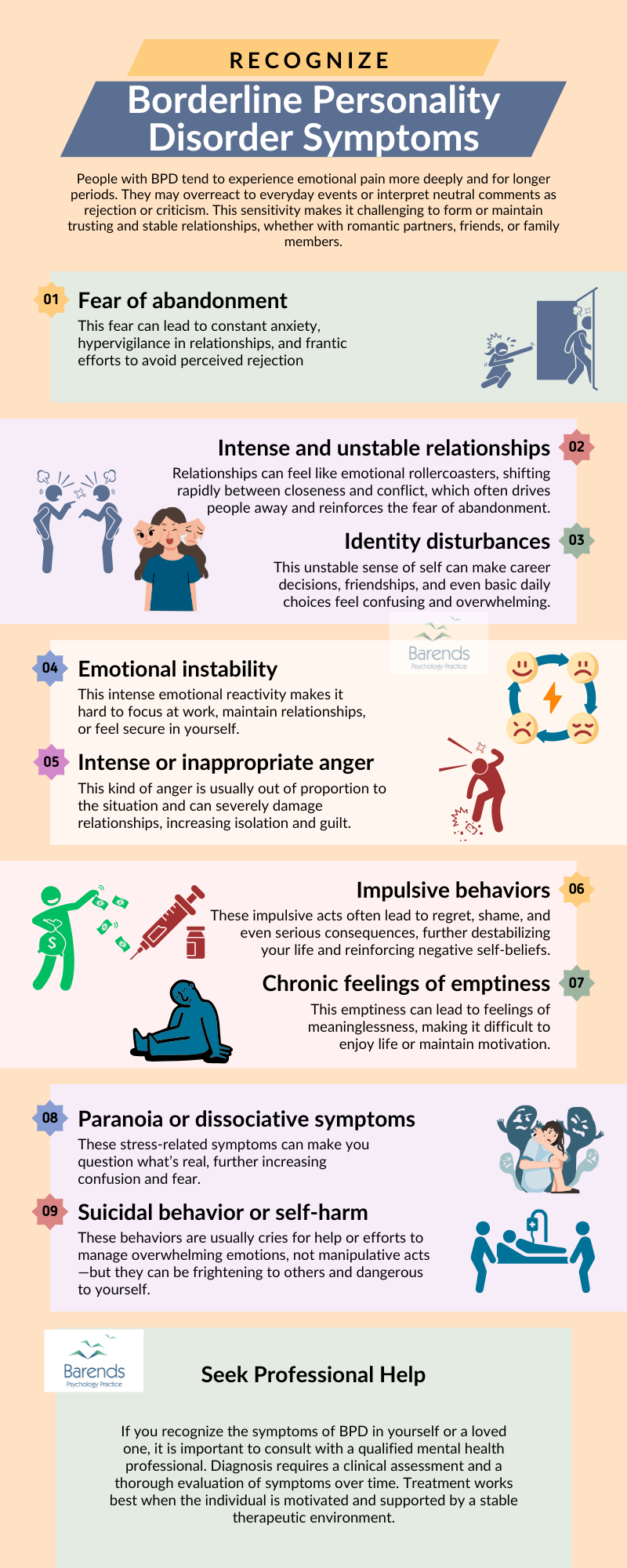
A borderline personality disorder (BPD) diagnosis is essential for understanding your symptoms and choosing the most effective treatment. Without a clear diagnosis, patterns such as emotional instability and fear of abandonment can easily be misunderstood or misdiagnosed.
Many people struggling with these symptoms initially receive different explanations, such as depression or trauma-related disorders (C-PTSD). While these conditions can overlap, borderline personality disorder is defined by a specific pattern of emotional, cognitive, and relational difficulties. You can read more about these patterns on the BPD symptoms page.
A correct diagnosis does not only provide clarity, it directly influences the type of treatment you receive. Evidence-based approaches such as Schema Therapy and Dialectical Behaviour Therapy (DBT) are specifically designed for BPD and are significantly more effective when the underlying diagnosis is accurate.
On this page, you will learn how borderline personality disorder is diagnosed using the DSM-5-TR and ICD-11 and why diagnosis is a crucial step toward long-term emotional stability and recovery.
Niels Barends, MSc, psychologist at Barends Psychology Practice

Written by:
Niels Barends, MSc
Psychologist and founder of Barends Psychology Practice
14+ years of clinical experience treating trauma, personality disorders, and complex relationship dynamics.
Specialized in Schema Therapy, Cognitive Behavioural Therapy (CBT), and EMDR.
Last reviewed: June 2026
Key insights about BPD diagnosis
- BPD symptoms often overlap with PTSD, depression, and bipolar disorder.
- A correct diagnosis is essential for choosing effective, evidence-based treatment.
- Misdiagnosis can lead to ineffective or delayed treatment.
- Structured therapies such as DBT and Schema Therapy are specifically designed for BPD.
- An early diagnosis improves long-term outcomes and emotional stability.
Not sure if your symptoms match BPD?
Start with a quick self-test or get a professional assessment for more clarity.
Navigate this topic:
-
Understand borderline personality disorder
What is BPD? •
Symptoms explained -
Causes
What causes BPD? -
Treatment and professional support
Treatment options •
Start online therapy -
Self-assessment and coping
Take the BPD test •
Coping strategies -
Relationships and daily impact
Living with someone with BPD -
Additional insights
BPD facts •
Homepage
Borderline personality disorder diagnosis according to the DSM-5-TR
According to the DSM-5-TR (Diagnostic and Statistical Manual of Mental Disorders, Fifth Edition, Text Revision), borderline personality disorder is diagnosed based on persistent impairments in personality functioning and characteristic pathological personality traits.
Clinical note: The DSM-5-TR criteria below are primarily used by mental health professionals during a structured assessment. They are included here to explain how diagnosis works in practice.
(A) Significant impairments in personality functioning
For a diagnosis of BPD, there must be clear problems in both self-functioning and interpersonal functioning.
-
1. Impairments in self-functioning
Identity: a markedly unstable, poorly developed, or fragile self-image, often associated with excessive self-criticism, chronic emptiness, or dissociative states under stress.
Self-direction: instability in goals, values, aspirations, or career direction.
AND
-
2. Impairments in interpersonal functioning
Empathy: difficulty accurately recognizing the feelings and needs of others, often combined with interpersonal hypersensitivity and a tendency to feel insulted or slighted.
Intimacy: intense, unstable, and conflicted close relationships marked by mistrust, emotional dependency, and strong fears of real or imagined abandonment. Relationships often shift between idealization and devaluation, or between overinvolvement and withdrawal.
(Advertisement. For more information, please scroll down.)
(B) Pathological personality traits
In addition to impairments in personality functioning, the DSM-5-TR requires characteristic pathological personality traits in the following domains:
-
1. Negative Affectivity
Emotional lability: unstable emotional experiences and frequent mood changes; emotions are easily triggered, intense, and often disproportionate to the situation.
Anxiousness: intense nervousness, tension, or panic, especially in response to interpersonal stress; fear of uncertainty, loss of control, or “falling apart.”
Separation insecurity: strong fears of rejection or separation from important others, often combined with dependency and fear of losing autonomy.
Depressivity: frequent feelings of hopelessness, shame, worthlessness, pessimism, and in some cases suicidal thoughts or behaviour.
-
2. Disinhibition
Impulsiveness: acting quickly in response to emotional triggers, without considering consequences; difficulty making or following plans; urgency and self-harming behaviour under distress.
Risk taking: engaging in dangerous or self-damaging activities without sufficient regard for consequences or personal safety.
-
3. Antagonism
Hostility: persistent anger, irritability, or frequent angry reactions, often in response to minor slights or perceived insults.
Additional DSM-5-TR requirements: these patterns must be relatively stable over time, present across different situations, not better explained by the person’s developmental stage or cultural background, and not primarily caused by substance use or a medical condition.
(Advertisement. For more information, please scroll down.)
Borderline personality disorder diagnosis according to the ICD-11
The ICD-11 (International Classification of Diseases, 11th Edition) approaches personality disorders somewhat differently from the DSM-5-TR. Instead of focusing on specific disorder categories, it first evaluates the presence and severity of a personality disorder and then allows an additional specification, such as Borderline Pattern.
To meet the ICD-11 Borderline Pattern specification, a person must first meet the criteria for a personality disorder and then show at least five of the following features:
-
Marked impulsivity
Difficulty delaying gratification or considering consequences, especially when emotionally distressed.
Example: spending large amounts of money, binge eating, unsafe sex, or reckless driving after conflict or emotional overwhelm. -
Severely unstable relationships
Intense, chaotic relationships that shift rapidly between idealization and devaluation.
Example: deeply admiring a partner one day and angrily rejecting them the next after a perceived slight. -
Fear of abandonment
Extreme sensitivity to real or perceived rejection or separation.
Example: panicking when someone is late or does not respond quickly, sometimes leading to desperate attempts to keep them close. -
Emotional instability due to reactivity
Rapid and intense emotional responses, especially in interpersonal situations.
Example: becoming intensely angry, desperate, or depressed for hours after a relatively minor disagreement. -
Chronic feelings of emptiness
A persistent sense of inner void, numbness, or lack of meaning.
Example: feeling hollow or disconnected even when surrounded by others. -
Poor self-image or unstable sense of self
An inconsistent or unclear identity, including unstable goals, values, or self-worth.
Example: feeling confident and purposeful one day, then worthless or directionless the next. -
Intense or poorly controlled anger
Difficulty managing anger, often out of proportion to the situation.
Example: reacting with rage to mild criticism or feeling deeply insulted by small comments. -
Stress-related paranoia or dissociation
Under high stress, brief paranoid thoughts or dissociative symptoms may occur.
Example: feeling unreal, detached, or as if observing yourself from outside after emotional overload. -
Suicidal behaviour or self-harm
Recurrent suicidal thoughts, suicide attempts, or deliberate self-injury, often in response to overwhelming emotional pain.
Example: self-harming after a painful argument or after feeling rejected, in order to regain relief or control.
(Advertisement. For more information, please scroll down.)
DSM-5-TR vs ICD-11: Key Differences
| Feature | DSM-5-TR | ICD-11 |
|---|---|---|
| Structure | Categorical + dimensional hybrid model | Fully dimensional model |
| Focus | Specific diagnostic criteria for BPD | General personality disorder + optional “Borderline Pattern” |
| Diagnosis | Requires specific traits + functional impairments | Requires personality disorder + ≥5 borderline traits |
| Severity assessment | Optional (Alternative Model) | Required (Mild / Moderate / Severe) |
| Clinical use | Commonly used in the U.S. and parts of Europe | WHO standard, used worldwide |
In practice: Both systems describe the same core patterns of borderline personality disorder. The DSM-5-TR focuses more on specific symptom clusters, while the ICD-11 emphasizes severity and underlying personality traits. In clinical settings, professionals may use either system—or both—to guide diagnosis and treatment planning.
Get a Clear Diagnosis and Personalised Treatment Plan
If you recognize symptoms such as emotional instability or fear of abandonment, a structured assessment can help clarify what is going on.
At Barends Psychology Practice, we use both DSM-5-TR and ICD-11 frameworks to provide an accurate diagnosis and tailored treatment plan.
You don’t need to figure this out alone. A clear diagnosis is often the first step toward more stability, better relationships, and effective treatment.
Borderline Personality Disorder Diagnosis – Frequently Asked Questions
How is borderline personality disorder diagnosed?
Borderline personality disorder is diagnosed through a structured psychological assessment conducted by a qualified mental health professional. This typically includes a clinical interview, evaluation of current symptoms, personal history, and how these patterns affect daily functioning.
Clinicians use diagnostic frameworks such as the DSM-5-TR or ICD-11 to determine whether the criteria for BPD are met. The focus is not only on symptoms, but also on patterns over time, emotional regulation, and interpersonal functioning.
Can borderline personality disorder be misdiagnosed?
Yes, BPD can sometimes be misdiagnosed because its symptoms overlap with other conditions such as depression, anxiety disorders, bipolar disorder, or trauma-related disorders. For example, mood instability may resemble bipolar disorder, while fear of abandonment can resemble trauma-related responses.
A thorough assessment is essential to distinguish between these conditions. Accurate diagnosis ensures that treatment is targeted and effective, rather than addressing only surface-level symptoms.
Can borderline personality disorder be diagnosed online?
Yes, BPD can be assessed through online therapy when conducted by a qualified psychologist using structured interviews and validated diagnostic frameworks. Online assessment can be just as effective as in-person evaluation when done professionally.
However, self-tests should only be used as an initial indication and not as a formal diagnosis. A professional evaluation is always recommended for clarity and appropriate treatment planning.
Why is an accurate diagnosis important for treatment?
An accurate diagnosis allows clinicians to choose the most effective treatment approach. For borderline personality disorder, evidence-based therapies such as Dialectical Behaviour Therapy (DBT) and Schema Therapy are specifically designed to address emotional dysregulation, impulsivity, and relationship patterns.
Without a clear diagnosis, treatment may focus on symptoms rather than underlying patterns, which can slow progress or lead to recurring problems.
What is the difference between DSM-5-TR and ICD-11 in diagnosing BPD?
The DSM-5-TR uses a more structured set of criteria focused on specific symptoms and impairments, while the ICD-11 takes a broader approach by first assessing personality disorder severity and then specifying a borderline pattern.
In practice, both systems describe similar core features. Many clinicians use elements of both frameworks to gain a more complete understanding of the individual.
— Niels Barends, MSc, psychologist
Scientific References
- [1] Giesen-Bloo, J., van Dyck, R., Spinhoven, P., et al. (2006). Outpatient psychotherapy for borderline personality disorder: Schema-focused therapy vs transference-focused psychotherapy. Archives of General Psychiatry, 63, 649–658.
- [2] Verheul, R., Van Den Bosch, L. M. C., Koeter, M. W. J., et al. (2003). Dialectical behaviour therapy for women with borderline personality disorder: 12-month randomized clinical trial. The British Journal of Psychiatry, 182, 135–140.
- [3] American Psychiatric Association. (2022). Diagnostic and Statistical Manual of Mental Disorders (DSM-5-TR). Washington, DC: APA Publishing.
- [4] World Health Organization. (2019). International Classification of Diseases 11th Revision (ICD-11). Geneva: WHO.
- [5] Linehan, M. M. (1993). Cognitive-Behavioral Treatment of Borderline Personality Disorder. New York: Guilford Press.
- [6] Bateman, A., & Fonagy, P. (2004). Psychotherapy for Borderline Personality Disorder: Mentalization-Based Treatment. Oxford University Press.
- [7] Stoffers, J. M., Völlm, B. A., Rücker, G., et al. (2012). Psychological therapies for people with borderline personality disorder. Cochrane Database of Systematic Reviews, Issue 8.
- [8] Zanarini, M. C., Frankenburg, F. R., Hennen, J., et al. (2003). The longitudinal course of borderline psychopathology: 6-year prospective follow-up. American Journal of Psychiatry, 160, 274–283.
- [9] Paris, J. (2005). The development of impulsivity and suicidality in borderline personality disorder. Development and Psychopathology, 17, 1091–1104.
- [10] Gunderson, J. G., & Links, P. S. (2014). Handbook of Good Psychiatric Management for Borderline Personality Disorder. American Psychiatric Publishing.