


Relationship problems: causes and patterns.
Written by Niels Barends, MSc, psychologist with more than 14 years of clinical experience in relationship problems and communication patterns. Updated June 2026.

Relationship problems develop through small interaction patterns that repeat over time. A conversation turns into an argument, and a disagreement becomes a recurring conflict where one partner feels unheard, and the other feels criticized or misunderstood.
Many couples assume they are arguing about chores, intimacy, communication, money, or trust, but in reality, these issues often reflect deeper emotional patterns involving connection or unmet expectations. Some people seek reassurance when they feel disconnected. Others withdraw or become defensive. These differences can create recurring cycles that leave both partners feeling frustrated or distant.
The good news is that most relationship problems tend to follow recognizable patterns. Understanding those patterns is the first step toward improving communication and rebuilding trust. Many of these patterns are influenced by communication habits and deeper relational tendencies. Understanding how you and your partner naturally approach connection and emotional needs can provide valuable insight into recurring relationship difficulties.
On this page, you’ll learn how relationship problems develop and what you can do to create more constructive relationship dynamics.
Jump to
Quick facts about relationship problems
- Most relationship problems are caused by repeating interaction patterns
- Communication problems are one of the most common causes of relationship conflict
- Attachment styles strongly influence how partners deal with conflict and intimacy
- Many conflicts are not about the topic itself, but about feeling unheard or misunderstood
- Unresolved emotions (e.g. frustration, disappointment) tend to build up and resurface in arguments
- Healthy relationships are not conflict-free: they are defined by how conflicts are managed
- Early recognition of patterns increases the chance of repairing the relationship
- Professional support can help when patterns become repetitive or emotionally draining
Relationship counseling and online therapy
At Barends Psychology Practice, support is available for couples and individuals experiencing relationship problems, communication difficulties, trust issues, emotional distance, attachment-related concerns, and recurring conflict patterns. Sessions are available both online and in person.
If relationship difficulties are becoming repetitive or difficult to resolve, professional support can help identify the underlying patterns and create a clearer path forward.
How do people get relationship problems?
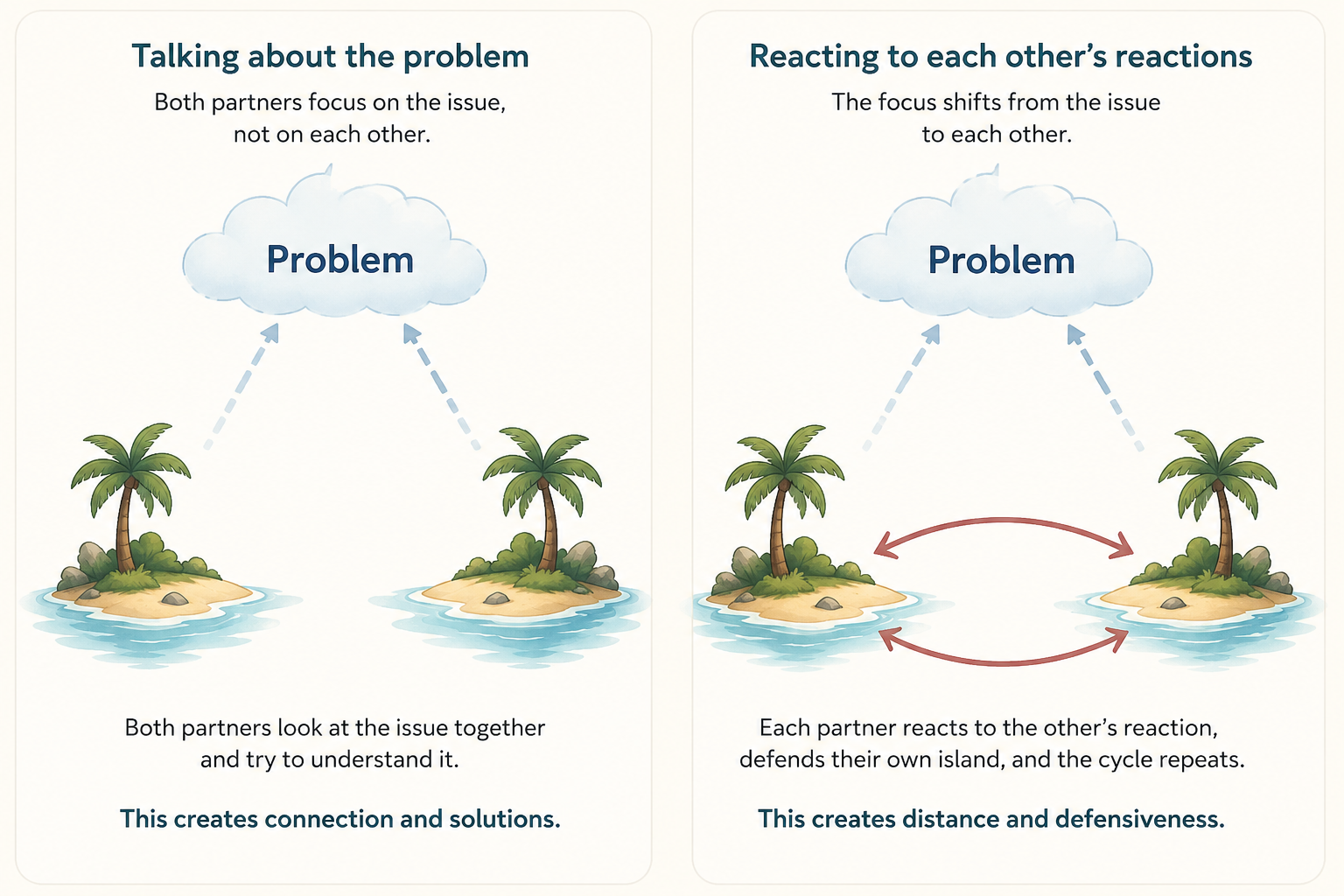
Most relationship problems begin when partners start reacting to each other’s reactions rather than to the original issue. A request for support feels like criticism, and the need for space feels like rejection. Each partner expects a certain response and adjusts accordingly, often to defend their own point of view. This is the moment couples create a self-reinforcing cycle. The behaviours that are meant to create connection end up producing distance or defensiveness instead. Recognizing this cycle is often the first step toward changing it.
Understanding the psychology behind relationship problems
Many relationship problems begin with a legitimate emotional need that is misunderstood. Imagine one partner says:
“I feel like we hardly spend any time together anymore.”
The intention may be to express a desire for more connection, but the other partner may hear criticism:
“Nothing I do is ever enough.”
The conversation quickly shifts away from the original need and becomes focused on defending positions. One partner tries harder to explain, whereas the other gets increasingly defensive. The more each person tries to solve the problem, the less understood they feel. These misunderstandings create recurring interaction patterns. One reason these patterns develop is that people approach relationships with different priorities. Some focus primarily on emotional connection. Others may value stability or practical support. These priorities influence how people interpret situations and communicate needs.
The Relational Archetypes describe five recurring relationship patterns that help explain these differences.
Relational Archetypes and Emotional Needs
| Archetype | Primary focus | Under pressure |
|---|---|---|
| Attuner | Emotional connection, understanding, closeness | May seek reassurance or become highly sensitive to distance |
| Builder | Reliability, commitment, practical support | May focus on responsibilities and solutions |
| Anchor | Stability, loyalty, consistency | May be increasingly protective of routines and relational security |
| Observer | Understanding, reflection, perspective | May withdraw or overthink situations to process emotions |
| Catalyst | Growth, change, possibility | May become restless or frustrated when the relationship feels stuck or repetitive |
Relationship difficulties frequently emerge when two people interpret the same situation through different relational priorities.
Example: An Attuner and an Observer
Imagine an Attuner and an Observer in a relationship. After a difficult day, the Attuner wants to talk about what happened and feel emotionally understood. Connection helps them feel secure. The Observer experiences the same situation differently. Before discussing emotions, they first need time to think and understand their own reactions.
The problem begins when both partners interpret the other’s behaviour through their own perspective.
The Attuner may think:
“They don’t want to talk to me. They are pulling away.”
The Observer may think:
“Why are they pushing me to talk before I’ve figured out what I think?”
The more the Attuner seeks connection, the more the Observer feels pressured. The more the Observer withdraws to think, the more the Attuner experiences distance. Both are attempting to meet a legitimate emotional need, but because those needs are expressed differently, a self-reinforcing cycle develops.
Many recurring relationship problems follow a similar pattern. Understanding how each partner experiences connection and emotional needs is the deeper challenge. When couples begin recognizing these underlying patterns, communication becomes easier because they stop arguing about the behaviour and start understanding the need behind it.
Discover Your Relational Pattern
Many relationship problems become easier to understand once you recognize the emotional needs and communication patterns that shape your relationships.
The free Relational Archetype assessment helps identify the relationship pattern that most influences how you create connection, respond to conflict, communicate needs, and experience emotional closeness.
Your results include a personalized profile and practical insights into the strengths and blind spots that may be affecting your relationships.
Common Relationship Problems
Relationship problems can take many forms. The sections below group the most common issues and link to more detailed self-help pages.
Communication Problems
- Tips to improving communication in relationships
- How to fix a relationship? – page about common relationship issues
Trust and Jealousy
- Overcoming trust issues in a few easy steps
- Dealing with jealousy in just a few steps
- How to overcome infidelity?
Emotional Challenges
- Dealing with fear of commitment
- How to overcome adult separation anxiety?
- How to deal with loneliness in a relationship?
Life Events and Relationship Stress
- Tips to getting over a break up
- How to deal with different cultural backgrounds in a relationship?
- How to recognize an abusive relationship?
Professional Support

Frequently asked questions about relationship problems
Are relationship problems normal?
Yes. Most relationships experience periods of tension or emotional distance. Problems are not necessarily a sign that a relationship is failing, but rather that differences or expectations are not fully aligned or communicated.
What are the most common relationship problems?
Common relationship problems include communication issues, trust problems, jealousy, emotional distance, recurring arguments, and difficulties with intimacy. These often reflect deeper patterns rather than isolated incidents.
Can relationship problems be solved without therapy?
Many relationship problems can improve with better communication and effort from both partners. However, when patterns become repetitive or difficult to change, therapy can provide structure and guidance.
When do relationship problems become serious?
Relationship problems become more serious when patterns are persistent or involve manipulation or emotional harm. In such cases, it is important to evaluate whether the relationship is still healthy.
Why do the same arguments keep happening?
Recurring arguments are often driven by underlying emotional patterns rather than the surface topic. For example, disagreements about daily issues may reflect deeper needs related to validation or feeling understood.
How do communication problems affect a relationship?
Communication problems can lead to misunderstandings and emotional distance. This may create negative interaction cycles where both partners feel unheard or defensive.
What is the first step to fixing relationship problems?
The first step is recognizing patterns in how you and your partner interact. This includes noticing triggers and recurring behaviours during conflict.
Can one person fix relationship problems alone?
One person can influence the dynamic by changing their own behaviour, but long-term improvement usually requires effort from both partners. Relationships are shaped by interaction patterns, not just individual actions.
How do attachment styles affect relationship problems?
Attachment styles influence how people respond to conflict and emotional needs. For example, some people seek reassurance, while others withdraw. Understanding these patterns can improve communication and connection.
When should you seek professional help for relationship problems?
It may be helpful to seek professional support when conflicts are frequent or emotional distance increases. Therapy can help identify patterns and provide tools to improve the relationship.
References
This article is informed by clinical experience and established psychological research on relationship problems, communication, attachment, conflict dynamics, and emotional regulation.
- Gottman, J. M., & Silver, N. (2015). The Seven Principles for Making Marriage Work. Harmony Books.
- Johnson, S. M. (2019). Attachment Theory in Practice: Emotionally Focused Therapy with Individuals, Couples, and Families. Guilford Press.
- Mikulincer, M., & Shaver, P. R. (2016). Attachment in Adulthood: Structure, Dynamics, and Change. Guilford Press.
- Bowlby, J. (1988). A Secure Base: Parent-Child Attachment and Healthy Human Development. Basic Books.
- Christensen, A., Doss, B. D., & Jacobson, N. S. (2020). Integrative Behavioral Couple Therapy: A Therapist’s Guide to Creating Acceptance and Change. W. W. Norton.
- Beck, A. T. (1988). Love Is Never Enough: How Couples Can Overcome Misunderstandings, Resolve Conflicts, and Solve Relationship Problems Through Cognitive Therapy. Harper & Row.
- Greenberg, L. S., & Johnson, S. M. (1988). Emotionally Focused Therapy for Couples. Guilford Press.
- American Psychological Association. (2020). Publication Manual of the American Psychological Association (7th ed.). American Psychological Association.